
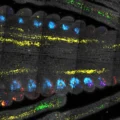
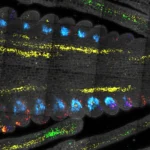
As cells contract and reshape to enable tissue morphogenesis, their own internal structures can constrain these behaviors. In the Drosophila germband, the uncrowding of nuclei away from an initially common plane is required for efficient cell intercalation and extension. Here, we find that a centrosomally derived microtubule network transitions into non-centrosomal arrays that are deeply embedded in nuclei before shifting towards the apical cortex as GBE progresses. Disrupting ncMT function by compromising CLASP or Patronin function leads to failures in nuclear dispersion and results in MT networks dominated by centrosomal arrays. CLASP disruption also causes a marked detachment of MTs from nuclei, severely affecting nuclear orientation and dispersion. Our results also reveal a fundamental antagonism between ncMT and centrosomal networks—an observation corroborated in γ-tubulin embryos. Lastly, EB1 disruption blocks the apical shift of ncMTs, leading to dispersion defects. Overall, our findings reveal that nuclear repositioning during epithelial remodeling depends on a centrosome-to-ncMT transition requiring CLASP, EB1, and Patronin function.

















No Comments
Leave a comment Cancel